





Live Interactive Classes
Hiring Partners
Guaranteed Job Referrals
Avg. Salary Hike






Our Data Science Specialization Course is designed for tech professionals seeking comprehensive training in Python programming. It covers a wide range of topics, including Data Analytics, Web Scraping, Machine Learning, NLP, and Deep Learning. You will also learn about Database Management, Data Visualization with Power BI and Tableau, and version control using GitHub. By completing this course, you will acquire extensive knowledge and expertise in essential Data Science tools and techniques using Python, including MLOps and Data Pipeline.
Our Data Science Specialization Course is designed for tech professionals seeking comprehensive training in Python programming. It covers a wide range of topics, including Data Analytics, Web Scraping, Machine Learning, NLP, and Deep Learning. You will also learn about Database Management, Data Visualization with Power BI and Tableau, and version control using GitHub. By completing this course, you will acquire extensive knowledge and expertise in essential Data Science tools and techniques using Python, including MLOps and Data Pipeline.
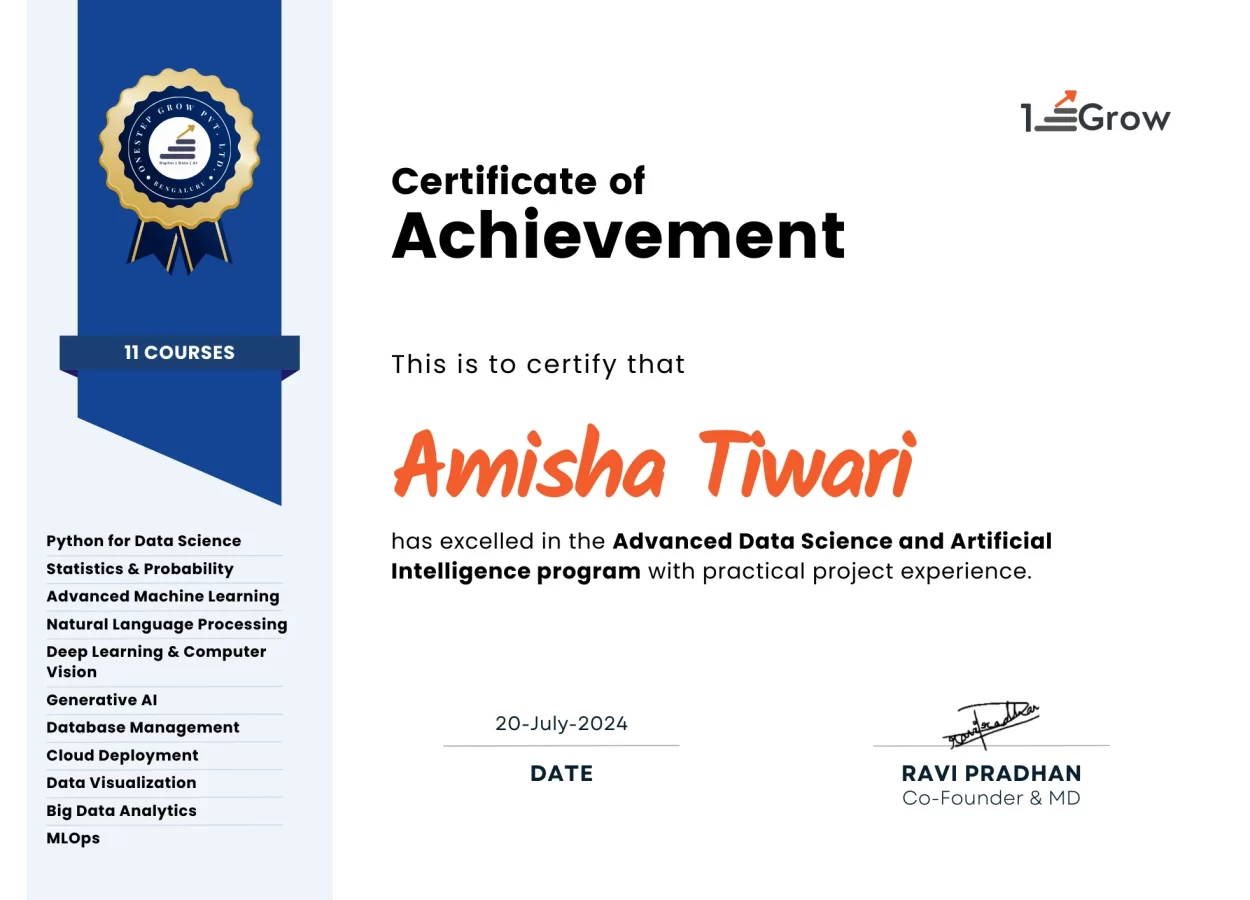
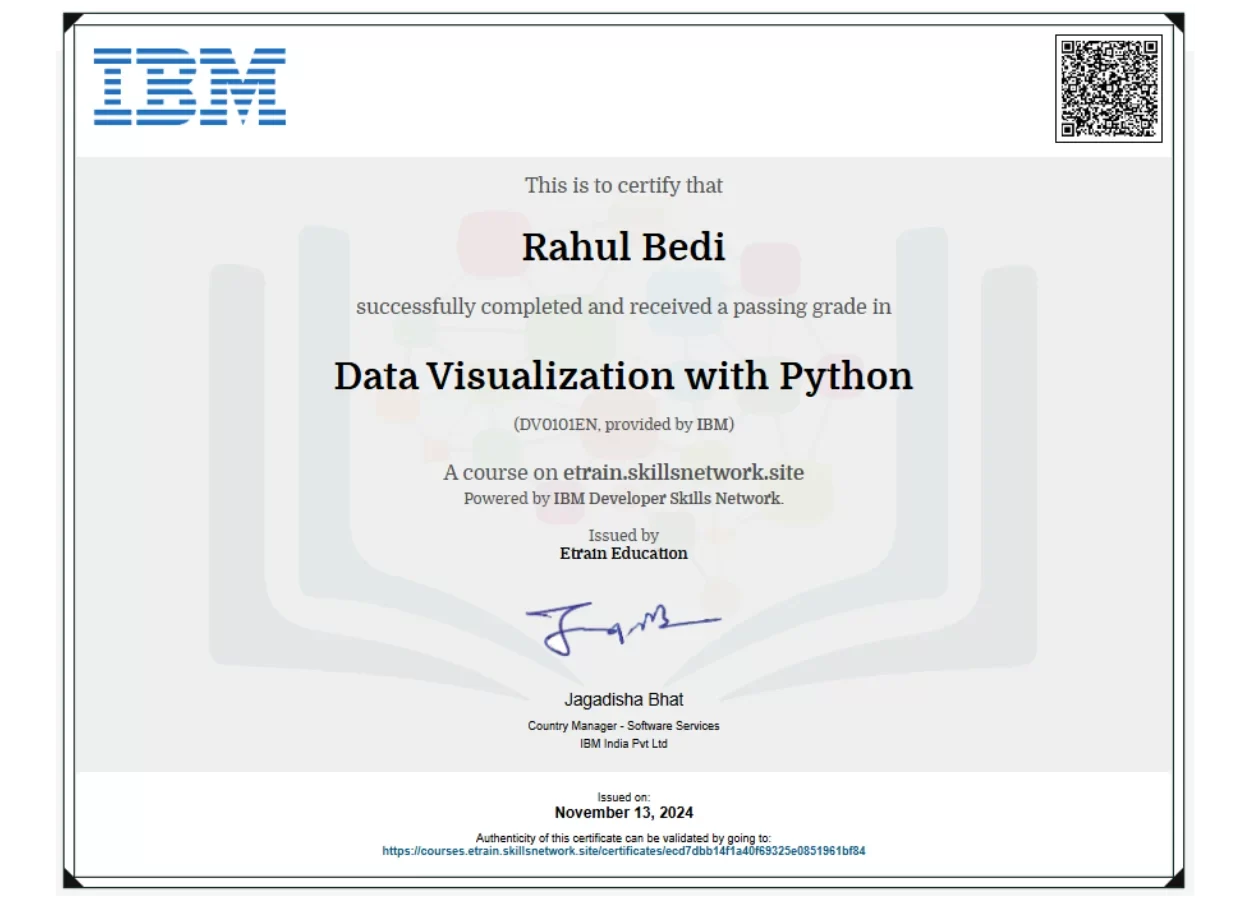
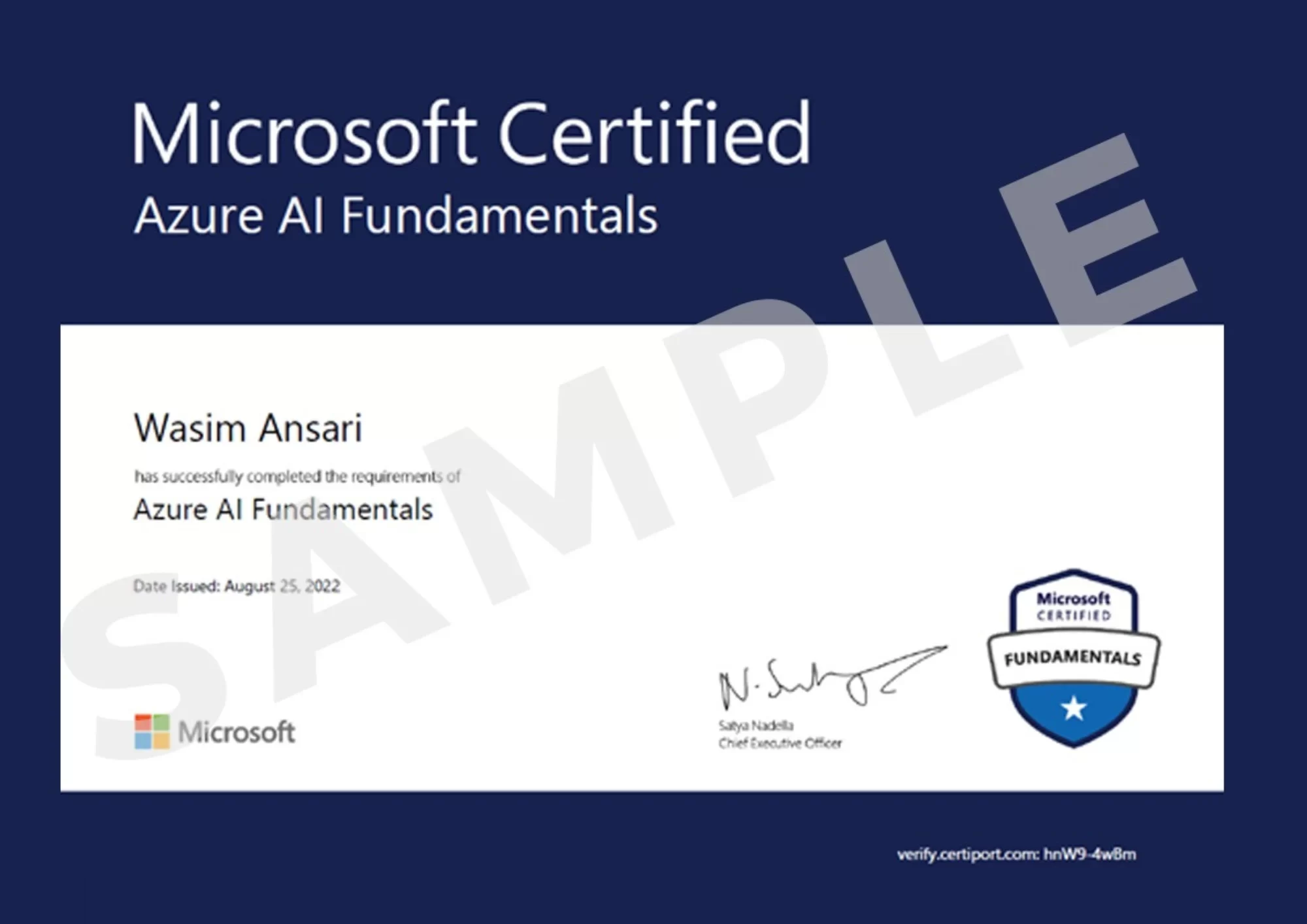
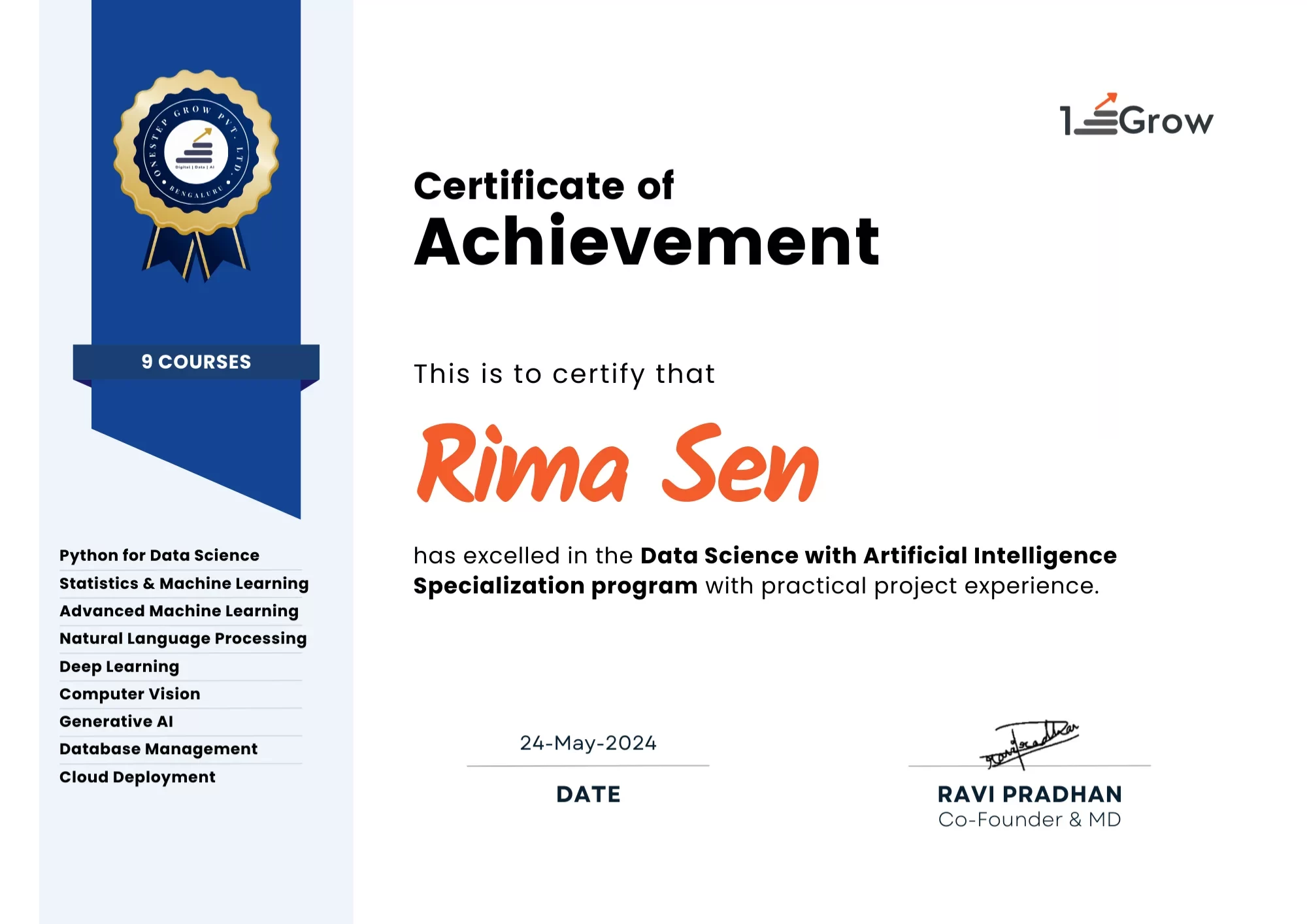
Dual Certification

Graduates from computer science, mathematics, or a related field

Professionals with experience in technology background

Early to mid-career professionals seeking career leap

Ambitious individuals aiming for hands-on experience
Harness Extensive Industry Network of 510+ Companies with Relevant Skills
Syllabus | Data Science Specialization Course
Still Not Sure About The Course?
Avoid Confusion, Choose The Right Option That Suits Your Needs.
Syllabus | Data Science Specialization Course
1stepGrow’s industry-designed Data Science Specialization course, offers hands-on learning with real-world projects and live interactive classes. With guaranteed job referrals, gain practical experience and a competitive edge in the data and AI field. Immerse yourself in a comprehensive program developed by industry experts, ensuring you acquire the necessary skills for success.
1stepGrow’s industry-designed Data Science Specialization course, offers hands-on learning with real-world projects and live interactive classes. With guaranteed job referrals, gain practical experience and a competitive edge in the data and AI field. Immerse yourself in a comprehensive program developed by industry experts, ensuring you acquire the necessary skills for success.
This unit serves as a primer for data science, introducing key tools and concepts. It’s designed to equip non-programmers with foundational Python skills, facilitating a deeper understanding and practical application throughout the course.
Module 1: Introduction To Data Science, Analytics & Artificial Intelligence
Module 2: Fundamentals of Programming
Tools Covered: Python, Anaconda, Jupyter, Google Colab
Module 3: Fundamentals of Statistics
Note:
Module 2 and Module 3 of Unit 1 are specially designed for non-programmers to understand the basics of computer programming and math.
This unit provides an extensive roadmap for building a robust portfolio in data science. You’ll master GitHub, a version control system, for efficient collaboration and project management. Additionally, you’ll harness LinkedIn‘s power for networking and career advancement
.
Module 1: Git & GitHub (VCS)
Class Hands-On: Initiate, collaborate, and work on a real-time project
Tools Covered: Git, GitHub
Module 2: LinkedIn Profile building
This Python course introduces fundamental to advanced concepts tailored for data science and AI applications. Learn Python step by step from basics to advanced. Learn all libraries, functions, and modules to perform data science projects by analyzing and building ML & AI models using Python.
Module 1: Core Python Programming
Project: Build a simple calculator
Module 2: Advanced Python Programming
Class Hands-on:
25+ programs/coding exercises on data types, loops, operators, functions, generators, file I/O, reg-ex, and exception handling
Module 3: Web Scraping using Python
Project: Scrape and Analyze Data from a Website (2-3 Projects)
Module 4: OOPs in Python
Module 5: Python For Data Analytics
Tools Covered: NumPy, Pandas, MatplotLib, Seaborn, Beautiful Soup
EDA Project (Create Insights using Data Analytics)
2 Full-Length Projects on Data Analytics using Pandas, MatplotLib & Seaborn to analyze Data to Gain Insights and Identify Patterns.
This course provides a comprehensive overview of statistical concepts and machine learning techniques, along with their practical applications. You will learn machine learning algorithms, explore various case studies to understand real-world applications and build models to reinforce your learning.
Module 1: Statistics & Probability
Class Hands-on:
Problem-solving for central tendency, ANOVA, central limit theorem & hypothesis testing Case study
Module 2: Machine Learning
Project:
The Time Series Analysis course will help you learn how to model, forecast, and analyze time-based data that contains date and time parameters. The NLP specialization will help you gain experience in techniques such as; text preprocessing, sentiment analysis, and building text-based models.
Module 1: Time-Series Data Analysis
Class Projects:
Tools Covered: SciKit Learn, Pandas, Matplotlib
Module 2: NLP
Class Projects:
Tools Covered: NLTK, Spacy, BERT
Learn practically data mining, optimizing query performance, and ensuring data integrity on SQL. Advanced topics include NoSQL databases like MongoDB, distributed systems, and data warehousing, preparing students for diverse data roles.
Module 1: SQL – Structured Query Language
Hands-on practice:
Module 2: MongoDB
Tools Covered: MySQL, SQL Server, MongoDB
In this cloud deployment unit, you will learn to deploy machine learning and AI models using AWS and Azure, two leading cloud platforms. You’ll gain proficiency in deploying, scaling, and managing models in the cloud environments through practical exercises.
Module 1: AWS
Module 2: Azure
Tools Covered: AWS, EC2, S3, ECS, Sagemaker, Lambda, Azure, Azure ML, Flask, Django
Module 1: Advanced Machine Learning
Tools Covered: Pandas, Matplotlib, Sk Learn, LightGBM
Class Projects:
Note: All Machine Learning Algorithms will be covered in depth with real-time projects & case studies for each algorithm. Once Machine learning is completed, the Capstone Project will be released for the batch.
Deep Learning, is a subset of machine learning that focuses on training neural networks to build a model by studying hierarchical patterns and features from the input data. On the other hand, in reinforcement Learning, you will learn to build a sequential model that interacts with the environment to achieve a goal by receiving real-time feedback.
Module 1: Deep Learning
Class Projects
Tools Covered: Tensorflow, Keras, PyTorch
Module 2: Reinforcement Learning
Class Projects:
In this unit, we’ll delve into computer vision for image analysis. We’ll explore image classification, object detection, and segmentation in computer vision using deep-learning architectures like CNNs.
Module 1: Computer Vision
Class Project:
In this unit, we’ll delve into generative AI and prompt engineering tools. Generative AI will introduce us to large language models, GANs, and autoregressive models for creating new content.
Module 1: Generative AI and Large Language Models
Tools Covered: Tensorflow, Open CV, BERT, Huggingface
Class Project:
This unit consists of two of the most prominently used tools for data visualization & analytics: Power BI and Tableau. You will learn to create interactive dashboards, reports, and visualizations to analyze and communicate insights effectively.
Module 1: Power BI
Class Project & Assignments:
Project 1: Education Institute’s student data analysis
Project 2: Sales Data Analysis
– Learn to visualize data to find patterns & insights using interactive charts
Module 2: Tableau
Class Project & Assignments:
Project 1: Supermarket data analysis
Project 2: Covid Data Analysis
– Learn to visualize data to find patterns & insights using interactive charts
– Deployment of Predictive model in Tableau
Tools Covered: Power BI, Tableau, Excel
Module 3: Excel for Analytics
Deep Learning, is a subset of machine learning that focuses on training neural networks to model and build a model that automatically discovers and learns hierarchical patterns and features from the input data.
Module 1: ANN (10 Hours)
Class Projects
In this unit, students will expertise to structure prompt instructions that can be interpreted, understood by generative AI models to provide an appropriate and effective response.
Module 1: Prompt Engineering
ChatGPT: Prompt for text Generation (Natural Language Processing)
Dall E / Midjourney: Prompt for image Generation
Synthesia for Video Generation & Slides AI for PPT creation
Tools Covered: ChatGPT, Midjourney, Dall E, MS Copilot, Synthesia, Invideo AI, Slides AI
In this unit, students will master the principles and practices of planning, organizing, executing, and controlling projects to achieve specific goals within constraints. Utilizing project management tools such as Asana, Trello, or Jira enhances efficiency in task management, collaboration, and tracking progress.
Module 1: Introduction to Project Management
Module 2: Agile & Scrum
Module 3: Jira
Tools Covered: Agile. Scrum, Jira, Kanban
This unit serves as a primer for data science, introducing key tools and concepts. It’s designed to equip non-programmers with foundational Python skills, facilitating a deeper understanding and practical application throughout the course.
Module 1: Introduction To Data Science, Analytics & Artificial Intelligence
Module 2: Fundamentals of Programming
Tools Covered: Python, Anaconda, Jupyter, Google Colab
Module 3: Fundamentals of Statistics
Note:
Module 2 and Module 3 of Unit 1 are specially designed for non-programmers to understand the basics of computer programming and math.
This unit provides an extensive roadmap for building a robust portfolio in data science. You’ll master GitHub, a version control system, for efficient collaboration and project management. Additionally, you’ll harness LinkedIn‘s power for networking and career advancement
.
Module 1: Git & GitHub (VCS)
Class Hands-On: Initiate, collaborate, and work on a real-time project
Tools Covered: Git, GitHub
Module 2: LinkedIn Profile building
This Python course introduces fundamental to advanced concepts tailored for data science and AI applications. Learn Python step by step from basics to advanced. Learn all libraries, functions, and modules to perform data science projects by analyzing and building ML & AI models using Python.
Module 1: Core Python Programming
Project: Build a simple calculator
Module 2: Advanced Python Programming
Class Hands-on:
25+ programs/coding exercises on data types, loops, operators, functions, generators, file I/O, reg-ex, and exception handling
Module 3: Web Scraping using Python
Project: Scrape and Analyze Data from a Website (2-3 Projects)
Module 4: OOPs in Python
Module 5: Python For Data Analytics
Tools Covered: NumPy, Pandas, MatplotLib, Seaborn, Beautiful Soup
EDA Project (Create Insights using Data Analytics)
2 Full-Length Projects on Data Analytics using Pandas, MatplotLib & Seaborn to analyze Data to Gain Insights and Identify Patterns.
This course provides a comprehensive overview of statistical concepts and machine learning techniques, along with their practical applications. You will learn machine learning algorithms, explore various case studies to understand real-world applications and build models to reinforce your learning.
Module 1: Statistics & Probability
Class Hands-on:
Problem-solving for central tendency, ANOVA, central limit theorem & hypothesis testing Case study
Module 2: Machine Learning
Project:
The Time Series Analysis course will help you learn how to model, forecast, and analyze time-based data that contains date and time parameters. The NLP specialization will help you gain experience in techniques such as; text preprocessing, sentiment analysis, and building text-based models.
Module 1: Time-Series Data Analysis
Class Projects:
Tools Covered: SciKit Learn, Pandas, Matplotlib
Module 2: NLP
Class Projects:
Tools Covered: NLTK, Spacy, BERT
Learn practically data mining, optimizing query performance, and ensuring data integrity on SQL. Advanced topics include NoSQL databases like MongoDB, distributed systems, and data warehousing, preparing students for diverse data roles.
Module 1: SQL – Structured Query Language
Hands-on practice:
Module 2: MongoDB
Tools Covered: MySQL, SQL Server, MongoDB
In this cloud deployment unit, you will learn to deploy machine learning and AI models using AWS and Azure, two leading cloud platforms. You’ll gain proficiency in deploying, scaling, and managing models in the cloud environments through practical exercises.
Module 1: AWS
Module 2: Azure
Tools Covered: AWS, EC2, S3, ECS, Sagemaker, Lambda, Azure, Azure ML, Flask, Django
Module 1: Advanced Machine Learning
Tools Covered: Pandas, Matplotlib, Sk Learn, LightGBM
Class Projects:
Note: All Machine Learning Algorithms will be covered in depth with real-time projects & case studies for each algorithm. Once Machine learning is completed, the Capstone Project will be released for the batch.
Deep Learning, is a subset of machine learning that focuses on training neural networks to build a model by studying hierarchical patterns and features from the input data. On the other hand, in reinforcement Learning, you will learn to build a sequential model that interacts with the environment to achieve a goal by receiving real-time feedback.
Module 1: Deep Learning
Class Projects
Tools Covered: Tensorflow, Keras, PyTorch
Module 2: Reinforcement Learning
Class Projects:
In this unit, we’ll delve into computer vision for image analysis. We’ll explore image classification, object detection, and segmentation in computer vision using deep-learning architectures like CNNs.
Module 1: Computer Vision
Class Project:
In this unit, we’ll delve into generative AI and prompt engineering tools. Generative AI will introduce us to large language models, GANs, and autoregressive models for creating new content.
Module 1: Generative AI and Large Language Models
Tools Covered: Tensorflow, Open CV, BERT, Huggingface
Class Project:
This unit consists of two of the most prominently used tools for data visualization & analytics: Power BI and Tableau. You will learn to create interactive dashboards, reports, and visualizations to analyze and communicate insights effectively.
Module 1: Power BI
Class Project & Assignments:
Project 1: Education Institute’s student data analysis
Project 2: Sales Data Analysis
– Learn to visualize data to find patterns & insights using interactive charts
Module 2: Tableau
Class Project & Assignments:
Project 1: Supermarket data analysis
Project 2: Covid Data Analysis
– Learn to visualize data to find patterns & insights using interactive charts
– Deployment of Predictive model in Tableau
Tools Covered: Power BI, Tableau, Excel
Module 3: Excel for Analytics
Deep Learning, is a subset of machine learning that focuses on training neural networks to model and build a model that automatically discovers and learns hierarchical patterns and features from the input data.
Module 1: ANN (10 Hours)
Class Projects
In this unit, students will expertise to structure prompt instructions that can be interpreted, understood by generative AI models to provide an appropriate and effective response.
Module 1: Prompt Engineering
ChatGPT: Prompt for text Generation (Natural Language Processing)
Dall E / Midjourney: Prompt for image Generation
Synthesia for Video Generation & Slides AI for PPT creation
Tools Covered: ChatGPT, Midjourney, Dall E, MS Copilot, Synthesia, Invideo AI, Slides AI
In this unit, students will master the principles and practices of planning, organizing, executing, and controlling projects to achieve specific goals within constraints. Utilizing project management tools such as Asana, Trello, or Jira enhances efficiency in task management, collaboration, and tracking progress.
Module 1: Introduction to Project Management
Module 2: Agile & Scrum
Module 3: Jira
Tools Covered: Agile. Scrum, Jira, Kanban
Gate a chance to win Upto 25% Scholarship
Take the test and prove your interest in Data Science and AI skill development for your batter career

Get a chance to win Upto 25% Scholarship
Take the test and prove your interest in Data Science and AI skill development for your batter career
Industry Projects


Wide Range Of Tools & Modules














Products in the markets are
1stepGrow provides you with
1stepGrow Data Science & Artificial Intelligence Course focuses on Focused Group Training with Live projects

Three years of live class support with access to various batches and instructors

Never miss a session with unlimited access to recorded classes

Get offline feeling in online mode: unmute, ask, and clear doubts in real time

Advantage for revision: get lifetime access to class recordings and material
Invest in your future with quality education
Program Fee:
₹ 89,000
+ 18% GST
Multiple Payment Modes
Payment Partner






Invest in your future with quality education
Program Fee:

Still Not Sure About The Course?
Avoid Confusion, Choose The Right Option That Suits Your Needs.
Domain Specialization
NEXT COHORTS DATES
Weekday Batch
(Mon-Fri)
Weekend Batch
(Sat-Sun)
NEXT COHORTS DATES
Weekday Batch (Mon-Fri)
Weekend Batch (Sat-Sun)

Thanks to 1stepGrow team, I am a successful Data Scientist. Transitioning from a teacher to the Data Science field was challenging, but the support and real-time project experience provided by 1stepGrow during the COVID pandemic made a significant difference. I am grateful for the personalized training and guidance from Ravi and the team. Today, I am proud to be working as a Data Scientist at Shyena Tech Yarn.

The Advanced Data Science and AI program at
1stepGrow Academy has exceeded my
expectations. With 14+ years of technical
experience, I still gained fresh insights,
particularly in my already known topics. The
trainers deliver thorough instruction in all topics;
technical or conceptual, breaking down complex
concepts with clarity and patience. The curated
course is exceptional and the recommended
tutorials are high-quality and domain-standard.
The training's depth rivals that of leading
universities, providing significant career
advancement. The management and training at
1stepGrow have been instrumental in my
further skill development.

My experience with 1stepGrow was fantastic. Their exceptional support enabled me to transition to the Data Science team in my company. Through hands-on work in the IT domain, I gained a deep understanding of the practical aspects of being a Data Scientist. The journey was seamless, thanks to the real-world experience provided by 1stepGrow.

1stepGrow is an excellent training institute for Data Science. Despite being a startup, I opted for them due to their small batch size. The vibrant class environment and interactive trainers greatly enhanced my skills. The encouraging atmosphere allowed me to ask questions and actively participate. Within just 6 months, I achieved success as a Data Analyst. My journey with 1stepGrow was truly amazing.

Enrolling at 1stepGrow Academy has been a fantastic experience. Their knowledgeable and approachable tutors break down complex concepts into easy-to-understand explanations. Small class sizes ensure personalized attention, and the well-organized administration communicates promptly. This training helped me secure a promotion at J.P. Morgan. Overall, 1stepGrow Academy exceeded my expectations, and I highly recommend it for mastering essential corporate applications.

Coming from a mechanical background, I enrolled in 1stepgrow's Data Science program. The mentors provided exceptional support, helping me understand the concepts. Their guidance was invaluable, leading me to secure a job even before completing the program. The personalized attention and focused learning approach allowed me to ask multiple doubts and receive proper guidance.

I completed the Advanced course from
1stepGrow, and it proved to be a comprehensive learning experience. The training
included a balanced mix of theory, practical sessions, and industry projects that equipped me with real-world skills. The instructors were
knowledgeable and provided strong support throughout. With additional offerings like Microsoft Azure certification, this course is perfect for professionals looking to advance or
switch careers into the data science domain.
Get a chance to win Upto 25% Scholarship
Take the test and prove your interest in Data Science skill development for your batter career
The Data Science Specialization Course is designed to be beginner-friendly, starting from the basics. Students entering the program should have a minimum of two years of experience in technical roles within their organizations.
This Data Science Specialization Course focuses on developing the necessary skills in data science, AI, MLOps and Data Pipeline with domain specialization. The program includes:
In our Data Science Specialization Course, we emphasize the importance of personalized mentorship. To facilitate effective learning and promote frequent doubt-solving interactions, we limit the batch size to a maximum of 15 students. This approach guarantees individual attention and fosters an environment conducive to learning.
By enrolling in our Data Science Specialization Course, students gain a 3-year subscription. This grants them continuous access to live class support, mentorship from the institute, and job referrals throughout the subscription period.
The online training program for the Data Science Specialization Course offers students various benefits:
The Data Science Specialization Course lasts approximately 10 months (320 hours). It includes live training sessions, hands-on training on live projects, and interview preparations. Classes are conducted on both weekdays and weekends. The weekday batch spans 8 months, with classes from Monday to Friday for 2 hours per day. The weekend batch lasts for 10 months, with classes on Saturdays and Sundays for 3.5 hours per day.
The Data Science Specialization Course utilizes instructor-led online training, which involves real-time virtual sessions led by expert trainers. Through this approach, tech professionals actively participate in interactive sessions, enabling them to acquire knowledge, gain practical insights, and engage in discussions related to artificial intelligence and machine learning concepts.
If you happen to miss a live session in the Data Science Specialization Course, don’t fret. The instructor-led online training format ensures that recorded sessions are available for you to review at your convenience. This way, you can make up for the missed session and continue progressing in your learning journey.
A smaller batch size in the Data Science Specialization Course fosters an ideal learning environment. With a reduced number of participants, students have more opportunities to seek clarification and resolve their queries during the session. This personalized interaction with the trainer allows for a more focused and effective learning experience.
Certainly! We promote an interactive learning environment in the Data Science Specialization Course, where students can actively interact with the trainer and ask questions during the live training sessions. Our small class sizes, limited to a maximum of 15 students per batch, ensure effective student engagement and personalized attention.
Yes! The Data Science Specialization Course covers cloud deployment technologies such as AWS, Heroku, and Azure. Moreover, you’ll explore big data technologies like Hadoop, Spark and Kafka. These crucial subjects are integrated into the curriculum to ensure you develop a comprehensive skill set that meets industry demands and enables you to excel with large-scale data and cloud-based environments.
The Data Science Specialization Course accelerates your career in AI and ML. Solve complex problems using advanced algorithms, statistical models, and practical implementations. Gain hands-on experience with TensorFlow, Data Pipelines, MLOps and scikit-learn to develop intelligent systems and data-driven applications. Enhance career prospects in tech sectors with high demand for AI and ML professionals.
Yes, to assess your progress and understanding of the concepts taught, there will be periodic assessments and exams throughout the Data Science Specialization Course. These evaluations are designed to ensure that you have a strong grasp of the topics covered and to help you identify areas that may require additional focus.
Yes, upon completing the Data Science Specialization Course, you will receive lifetime access to the course materials. This includes recordings of the live sessions, class notes, assignments, and other learning resources. This ensures that you can refer back to the content whenever you need to revise or revisit any topic covered during the course.
Yes, the learning materials for the Data Science Specialization Course, including recorded sessions, assignments, and course materials, are accessible through our learning management system. This allows you to access the content on your mobile device, giving you the flexibility to learn on the go.
We understand that you may need to switch between batches with office commitments. If such a situation arises during the Data Science Specialization Course for Tech Professionals, you can contact our support team, and they will assist you in making the necessary batch transfer arrangements, depending on the availability of seats in the desired batch.
During the Data Science Specialization Course, you can expect comprehensive support from our team. This includes live class support, doubt-solving sessions, discussion forums, mentorship, and access to the learning materials. Our aim is to ensure that you have a smooth learning journey and that all your queries and concerns are addressed promptly.
Yes, practical training is an essential element of the Data Science Specialization Course. You’ll engage in hands-on projects, applying advanced AI and machine learning techniques to solve complex problems. This practical experience will sharpen your skills and enable you to excel in the application of AI and machine learning in various professional settings.
Real-time projects in the Data Science Specialization Course involve working with industry datasets (with confidential information altered). These projects provide hands-on experience, allowing tech professionals to apply concepts and algorithms to solve real-world problems. With a collection of 18 industry projects covering various scenarios, participants can practice the tools and techniques learned in the course and strengthen their skills in AI and machine learning.
Domain specializations in the Data Science Specialization Course involve industry-specific training through capstone projects and mentorship. These projects are sourced from different domains, allowing tech professionals to apply AI and machine learning techniques in real-world scenarios. Domain specializations are important for professionals as they enhance their expertise, provide hands-on experience in specific industries, and equip them with the skills needed.
The Data Science Specialization Course incorporates up to 2 end-to-end Capstone projects. These projects enable tech professionals to apply their skills and acquire practical experience by working on real-world scenarios in the fields of artificial intelligence and machine learning.
Project experience in our Data Science Specialization Course involves undertaking industry projects within specific domain specializations. Students collaborate in groups with mentorship support. Upon completion, the project is evaluated by our institute and partner company. If it meets the required standards, we issue a project experience certificate, recognizing your practical experience in artificial intelligence and machine learning.
Yes, the Data Science Specialization Course offers access to industry experts and mentors. Our instructors, with their extensive industry experience, will be available to provide guidance, share valuable knowledge, and mentor you throughout the course, enriching your understanding of AI and machine learning concepts in a professional setting.
Yes, the Data Science Specialization Course features a dedicated community forum where students can interact and collaborate. This forum allows you to engage with peers, discuss course-related topics, seek advice, and share your projects.
At 1stepGrow, we provide a dedicated student forum for participants of the Data Science Specialization Course. If you have any queries or face challenges while practicing, you can post your questions on the forum. Our trainers and fellow students actively engage on the forum, providing timely responses and solutions to your queries.
In the Data Science Specialization Course, we prioritize the resolution of doubts to ensure a comprehensive learning experience. We conduct doubt-solving sessions within the class to address any queries that arise during the course. Additionally, at the end of each module, dedicated doubt-solving sessions are conducted to reinforce understanding and clarify any remaining questions.
At 1stepGrow, we provide a dedicated student forum for participants of the Data Science Specialization Course. If you have any queries or face challenges while practicing, you can post your questions on the forum. Our trainers and fellow students actively engage on the forum, providing timely responses and solutions to your queries.
In the Data Science Specialization Course, we offer a Job Assistance program to aid participants in their career aspirations. This program is designed to provide support and resources to help participants find suitable job opportunities in the field of artificial intelligence and machine learning.
In the Data Science Specialization Course, mock interviews are conducted online using video mode. Feedback on your performance will be provided within a week. You will receive a recorded video of the interview, allowing you to identify areas for improvement in both soft skills and technical skills. This course includes up to 3 mock interviews.
Absolutely! We offer comprehensive job assistance to students upon the successful completion of the Data Science Specialization Course. Our placement cell provides support in resume development, interview readiness, and facilitates connections with relevant job openings in the artificial intelligence and machine learning industry. Our aim is to empower our students to thrive in their professional journey.
We provide job referrals to our students enrolled in the Data Science Specialization Course. Our placement assistance program connects you with our network of partner companies and consultancies, increasing your chances of finding suitable job opportunities.
To be eligible for job assistance from 1stepGrow, you need to meet certain criteria. This includes successfully completing all assessment tests with a score of 70% or higher, submitting assignments on time, completing real-time projects, and working on at least 1 Capstone project.
Yes, upon successful completion of the Data Science Specialization Course, you will receive a Course Completion Certificate from 1stepGrow. This certificate validates your proficiency in AI and machine learning, enhancing your professional credentials.
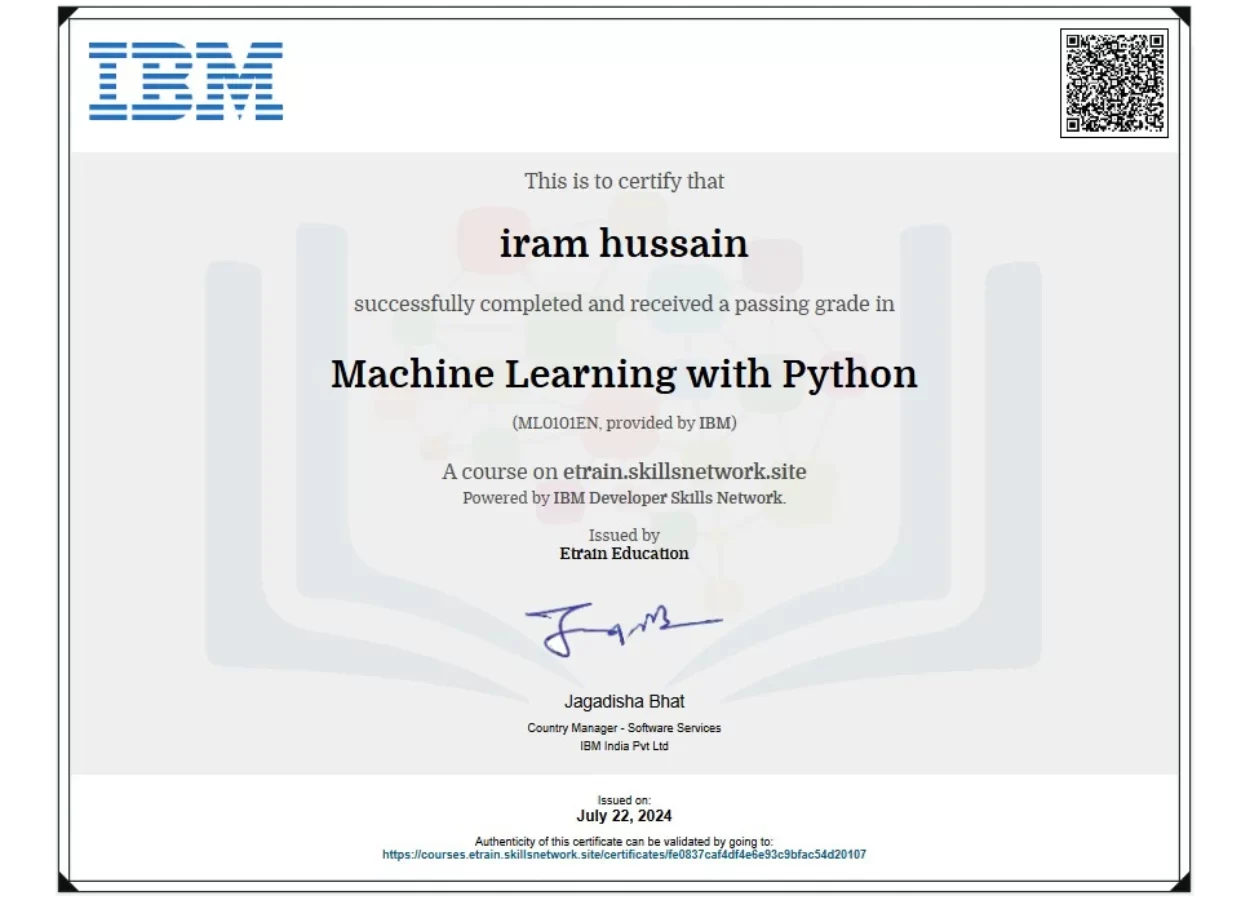
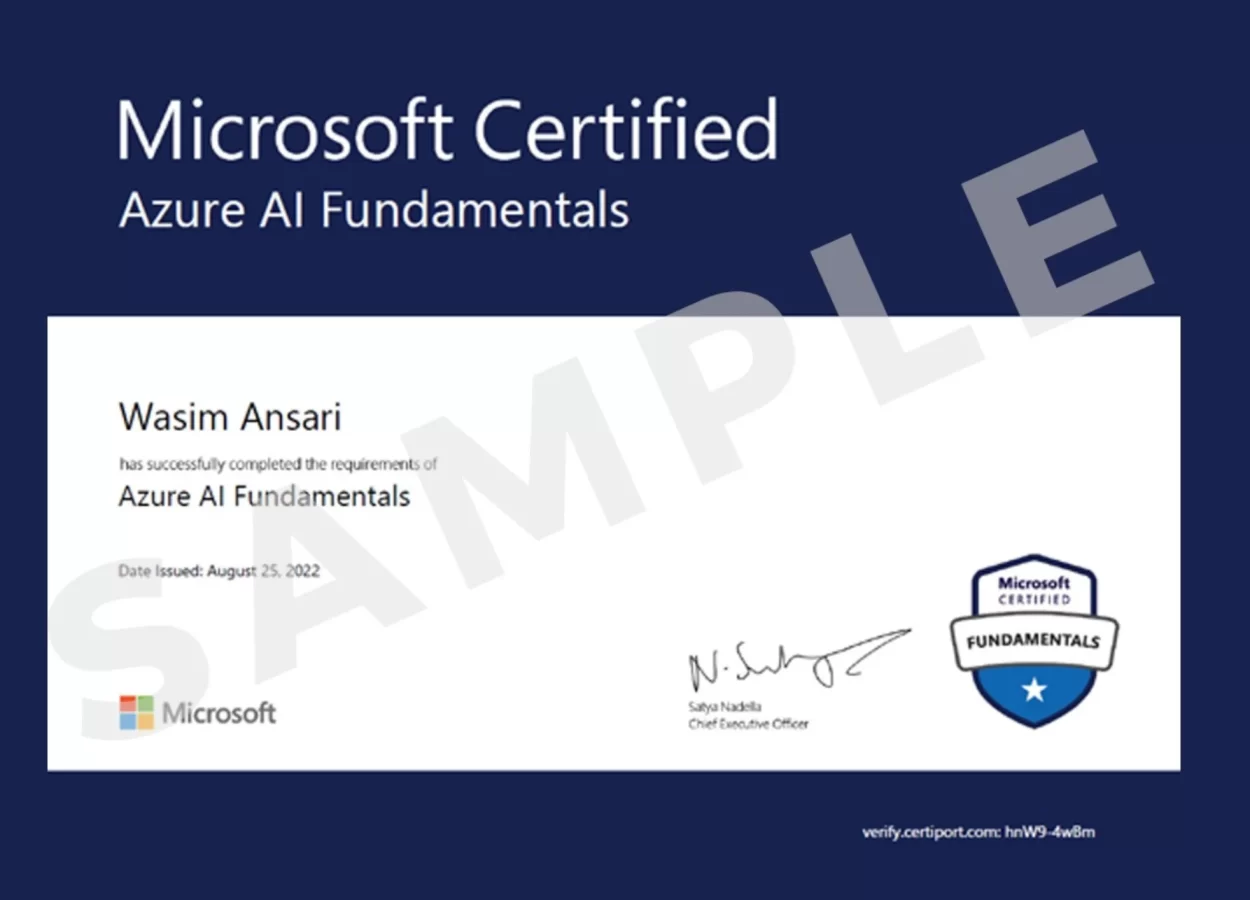
Yes, we offer academic certifications as part of the course. Our program includes training for industry-recognized certifications in Data Science Specialization. These certifications demonstrate your expertise in the field and can boost your career prospects. We are partnered with Microsoft. On successful completion of the assessment you will be awarded with a globally recognized AI certificate by Microsoft.
Absolutely! Our course provides you with the opportunity to work on real-world projects in collaboration with our partner companies. Upon successful completion of these projects, you will receive a Project Experience Certificate, showcasing your practical skills and project-based learning.
A project experience certification by a company holds immense value in the industry. It validates your practical skills and demonstrates your ability to apply Data Science Specialization concepts to real-world projects. This certification enhances your professional credibility and can significantly impact your career advancement.
The total fees for Data Science Specialization Course is INR 89,000/- + 18% GST
Yes, you can pay the fees in instalments by taking a no-cost EMI option for INR 5,835/month for a 12-month EMI. You can choose an interest free loan by submitting Aadhar, PAN, 3-month salary slip and other required documents to our banking partner.
Yes, we offer installment options for course fee payment in the Data Science Specialization Course. We recognize the financial considerations of our students and strive to provide flexible payment solutions. Feel free to contact our admissions team for further information on the available payment plans and choose the one that suits you best.
1stepGrow offers 15 – 20% scholarship on early-birds. Our counselors will inform you if an early bird discount is available for the course.
Group discounts are available to promote ease in program fees. The discount applies to all members of a group who join the course together. For a group of 2, there is a 5% extra discount, and for a group of 3 or more, there is a 10% extra discount.

Reach out to us and your career guide will get
in touch with you shortly
All Answers To Your Future Career
The Data Science Specialization Course is designed to be beginner-friendly, starting from the basics. Students entering the program should have a minimum of two years of experience in technical roles within their organizations.
This Data Science Specialization Course focuses on developing the necessary skills in data science, AI, MLOps and Data Pipeline with domain specialization. The program includes:
In our Data Science Specialization Course, we emphasize the importance of personalized mentorship. To facilitate effective learning and promote frequent doubt-solving interactions, we limit the batch size to a maximum of 15 students. This approach guarantees individual attention and fosters an environment conducive to learning.
By enrolling in our Data Science Specialization Course, students gain a 3-year subscription. This grants them continuous access to live class support, mentorship from the institute, and job referrals throughout the subscription period.
The online training program for the Data Science Specialization Course offers students various benefits:
The Data Science Specialization Course lasts approximately 10 months (320 hours). It includes live training sessions, hands-on training on live projects, and interview preparations. Classes are conducted on both weekdays and weekends. The weekday batch spans 8 months, with classes from Monday to Friday for 2 hours per day. The weekend batch lasts for 10 months, with classes on Saturdays and Sundays for 3.5 hours per day.
The Data Science Specialization Course utilizes instructor-led online training, which involves real-time virtual sessions led by expert trainers. Through this approach, tech professionals actively participate in interactive sessions, enabling them to acquire knowledge, gain practical insights, and engage in discussions related to artificial intelligence and machine learning concepts.
If you happen to miss a live session in the Data Science Specialization Course, don’t fret. The instructor-led online training format ensures that recorded sessions are available for you to review at your convenience. This way, you can make up for the missed session and continue progressing in your learning journey.
A smaller batch size in the Data Science Specialization Course fosters an ideal learning environment. With a reduced number of participants, students have more opportunities to seek clarification and resolve their queries during the session. This personalized interaction with the trainer allows for a more focused and effective learning experience.
Certainly! We promote an interactive learning environment in the Data Science Specialization Course, where students can actively interact with the trainer and ask questions during the live training sessions. Our small class sizes, limited to a maximum of 15 students per batch, ensure effective student engagement and personalized attention.
Yes! The Data Science Specialization Course covers cloud deployment technologies such as AWS, Heroku, and Azure. Moreover, you’ll explore big data technologies like Hadoop, Spark and Kafka. These crucial subjects are integrated into the curriculum to ensure you develop a comprehensive skill set that meets industry demands and enables you to excel with large-scale data and cloud-based environments.
The Data Science Specialization Course accelerates your career in AI and ML. Solve complex problems using advanced algorithms, statistical models, and practical implementations. Gain hands-on experience with TensorFlow, Data Pipelines, MLOps and scikit-learn to develop intelligent systems and data-driven applications. Enhance career prospects in tech sectors with high demand for AI and ML professionals.
Yes, to assess your progress and understanding of the concepts taught, there will be periodic assessments and exams throughout the Data Science Specialization Course. These evaluations are designed to ensure that you have a strong grasp of the topics covered and to help you identify areas that may require additional focus.
Yes, upon completing the Data Science Specialization Course, you will receive lifetime access to the course materials. This includes recordings of the live sessions, class notes, assignments, and other learning resources. This ensures that you can refer back to the content whenever you need to revise or revisit any topic covered during the course.
Yes, the learning materials for the Data Science Specialization Course, including recorded sessions, assignments, and course materials, are accessible through our learning management system. This allows you to access the content on your mobile device, giving you the flexibility to learn on the go.
We understand that you may need to switch between batches with office commitments. If such a situation arises during the Data Science Specialization Course for Tech Professionals, you can contact our support team, and they will assist you in making the necessary batch transfer arrangements, depending on the availability of seats in the desired batch.
During the Data Science Specialization Course, you can expect comprehensive support from our team. This includes live class support, doubt-solving sessions, discussion forums, mentorship, and access to the learning materials. Our aim is to ensure that you have a smooth learning journey and that all your queries and concerns are addressed promptly.
Yes, practical training is an essential element of the Data Science Specialization Course. You’ll engage in hands-on projects, applying advanced AI and machine learning techniques to solve complex problems. This practical experience will sharpen your skills and enable you to excel in the application of AI and machine learning in various professional settings.
Real-time projects in the Data Science Specialization Course involve working with industry datasets (with confidential information altered). These projects provide hands-on experience, allowing tech professionals to apply concepts and algorithms to solve real-world problems. With a collection of 18 industry projects covering various scenarios, participants can practice the tools and techniques learned in the course and strengthen their skills in AI and machine learning.
Domain specializations in the Data Science Specialization Course involve industry-specific training through capstone projects and mentorship. These projects are sourced from different domains, allowing tech professionals to apply AI and machine learning techniques in real-world scenarios. Domain specializations are important for professionals as they enhance their expertise, provide hands-on experience in specific industries, and equip them with the skills needed.
The Data Science Specialization Course incorporates up to 2 end-to-end Capstone projects. These projects enable tech professionals to apply their skills and acquire practical experience by working on real-world scenarios in the fields of artificial intelligence and machine learning.
Project experience in our Data Science Specialization Course involves undertaking industry projects within specific domain specializations. Students collaborate in groups with mentorship support. Upon completion, the project is evaluated by our institute and partner company. If it meets the required standards, we issue a project experience certificate, recognizing your practical experience in artificial intelligence and machine learning.
Yes, the Data Science Specialization Course offers access to industry experts and mentors. Our instructors, with their extensive industry experience, will be available to provide guidance, share valuable knowledge, and mentor you throughout the course, enriching your understanding of AI and machine learning concepts in a professional setting.
Yes, the Data Science Specialization Course features a dedicated community forum where students can interact and collaborate. This forum allows you to engage with peers, discuss course-related topics, seek advice, and share your projects.
At 1stepGrow, we provide a dedicated student forum for participants of the Data Science Specialization Course. If you have any queries or face challenges while practicing, you can post your questions on the forum. Our trainers and fellow students actively engage on the forum, providing timely responses and solutions to your queries.
In the Data Science Specialization Course, we prioritize the resolution of doubts to ensure a comprehensive learning experience. We conduct doubt-solving sessions within the class to address any queries that arise during the course. Additionally, at the end of each module, dedicated doubt-solving sessions are conducted to reinforce understanding and clarify any remaining questions.
At 1stepGrow, we provide a dedicated student forum for participants of the Data Science Specialization Course. If you have any queries or face challenges while practicing, you can post your questions on the forum. Our trainers and fellow students actively engage on the forum, providing timely responses and solutions to your queries.
In the Data Science Specialization Course, we offer a Job Assistance program to aid participants in their career aspirations. This program is designed to provide support and resources to help participants find suitable job opportunities in the field of artificial intelligence and machine learning.
In the Data Science Specialization Course, mock interviews are conducted online using video mode. Feedback on your performance will be provided within a week. You will receive a recorded video of the interview, allowing you to identify areas for improvement in both soft skills and technical skills. This course includes up to 3 mock interviews.
Absolutely! We offer comprehensive job assistance to students upon the successful completion of the Data Science Specialization Course. Our placement cell provides support in resume development, interview readiness, and facilitates connections with relevant job openings in the artificial intelligence and machine learning industry. Our aim is to empower our students to thrive in their professional journey.
We provide job referrals to our students enrolled in the Data Science Specialization Course. Our placement assistance program connects you with our network of partner companies and consultancies, increasing your chances of finding suitable job opportunities.
To be eligible for job assistance from 1stepGrow, you need to meet certain criteria. This includes successfully completing all assessment tests with a score of 70% or higher, submitting assignments on time, completing real-time projects, and working on at least 1 Capstone project.
Yes, upon successful completion of the Data Science Specialization Course, you will receive a Course Completion Certificate from 1stepGrow. This certificate validates your proficiency in AI and machine learning, enhancing your professional credentials.
Yes, we offer academic certifications as part of the course. Our program includes training for industry-recognized certifications in Data Science Specialization. These certifications demonstrate your expertise in the field and can boost your career prospects. We are partnered with Microsoft. On successful completion of the assessment you will be awarded with a globally recognized AI certificate by Microsoft.
Absolutely! Our course provides you with the opportunity to work on real-world projects in collaboration with our partner companies. Upon successful completion of these projects, you will receive a Project Experience Certificate, showcasing your practical skills and project-based learning.
A project experience certification by a company holds immense value in the industry. It validates your practical skills and demonstrates your ability to apply Data Science Specialization concepts to real-world projects. This certification enhances your professional credibility and can significantly impact your career advancement.
The total fees for Data Science Specialization Course is INR 89,000/- + 18% GST
Yes, you can pay the fees in instalments by taking a no-cost EMI option for INR 5,835/month for a 12-month EMI. You can choose an interest free loan by submitting Aadhar, PAN, 3-month salary slip and other required documents to our banking partner.
Yes, we offer installment options for course fee payment in the Data Science Specialization Course. We recognize the financial considerations of our students and strive to provide flexible payment solutions. Feel free to contact our admissions team for further information on the available payment plans and choose the one that suits you best.
1stepGrow offers 15 – 20% scholarship on early-birds. Our counselors will inform you if an early bird discount is available for the course.
Group discounts are available to promote ease in program fees. The discount applies to all members of a group who join the course together. For a group of 2, there is a 5% extra discount, and for a group of 3 or more, there is a 10% extra discount.
Reach out to us and your career guide will get
in touch with you shortly


We provide online certification in Data Science and AI, Digital Marketing, Data Analytics with a job guarantee program. For more information, contact us today!
Courses
1stepGrow
Anaconda | Jupyter Notebook | Git & GitHub (Version Control Systems) | Python Programming Language | R Programming Langauage | Linear Algebra & Statistics | ANOVA | Hypothesis Testing | Machine Learning | Data Cleaning | Data Wrangling | Feature Engineering | Exploratory Data Analytics (EDA) | ML Algorithms | Linear Regression | Logistic Regression | Decision Tree | Random Forest | Bagging & Boosting | PCA | SVM | Time Series Analysis | Natural Language Processing (NLP) | NLTK | Deep Learning | Neural Networks | Computer Vision | Reinforcement Learning | ANN | CNN | RNN | LSTM | Facebook Prophet | SQL | MongoDB | Advance Excel for Data Science | BI Tools | Tableau | Power BI | Big Data | Hadoop | Apache Spark | Azure Datalake | Cloud Deployment | AWS | GCP | AGILE & SCRUM | Data Science Capstone Projects | ML Capstone Projects | AI Capstone Projects | Domain Training | Business Analytics
WordPress | Elementor | On-Page SEO | Off-Page SEO | Technical SEO | Content SEO | SEM | PPC | Social Media Marketing | Email Marketing | Inbound Marketing | Web Analytics | Facebook Marketing | Mobile App Marketing | Content Marketing | YouTube Marketing | Google My Business (GMB) | CRM | Affiliate Marketing | Influencer Marketing | WordPress Website Development | AI in Digital Marketing | Portfolio Creation for Digital Marketing profile | Digital Marketing Capstone Projects
Jupyter Notebook | Git & GitHub | Python | Linear Algebra & Statistics | ANOVA | Hypothesis Testing | Machine Learning | Data Cleaning | Data Wrangling | Feature Engineering | Exploratory Data Analytics (EDA) | ML Algorithms | Linear Regression | Logistic Regression | Decision Tree | Random Forest | Bagging & Boosting | PCA | SVM | Time Series Analysis | Natural Language Processing (NLP) | NLTK | SQL | MongoDB | Advance Excel for Data Science | Alteryx | BI Tools | Tableau | Power BI | Big Data | Hadoop | Apache Spark | Azure Datalake | Cloud Deployment | AWS | GCP | AGILE & SCRUM | Data Analytics Capstone Projects
Anjanapura | Arekere | Basavanagudi | Basaveshwara Nagar | Begur | Bellandur | Bommanahalli | Bommasandra | BTM Layout | CV Raman Nagar | Electronic City | Girinagar | Gottigere | Hebbal | Hoodi | HSR Layout | Hulimavu | Indira Nagar | Jalahalli | Jayanagar | J. P. Nagar | Kamakshipalya | Kalyan Nagar | Kammanahalli | Kengeri | Koramangala | Kothnur | Krishnarajapuram | Kumaraswamy Layout | Lingarajapuram | Mahadevapura | Mahalakshmi Layout | Malleshwaram | Marathahalli | Mathikere | Nagarbhavi | Nandini Layout | Nayandahalli | Padmanabhanagar | Peenya | Pete Area | Rajaji Nagar | Rajarajeshwari Nagar | Ramamurthy Nagar | R. T. Nagar | Sadashivanagar | Seshadripuram | Shivajinagar | Ulsoor | Uttarahalli | Varthur | Vasanth Nagar | Vidyaranyapura | Vijayanagar | White Field | Yelahanka | Yeshwanthpur
Mumbai | Pune | Nagpur | Delhi | Gurugram | Chennai | Hyderabad | Coimbatore | Bhubaneswar | Kolkata | Indore | Jaipur and More


